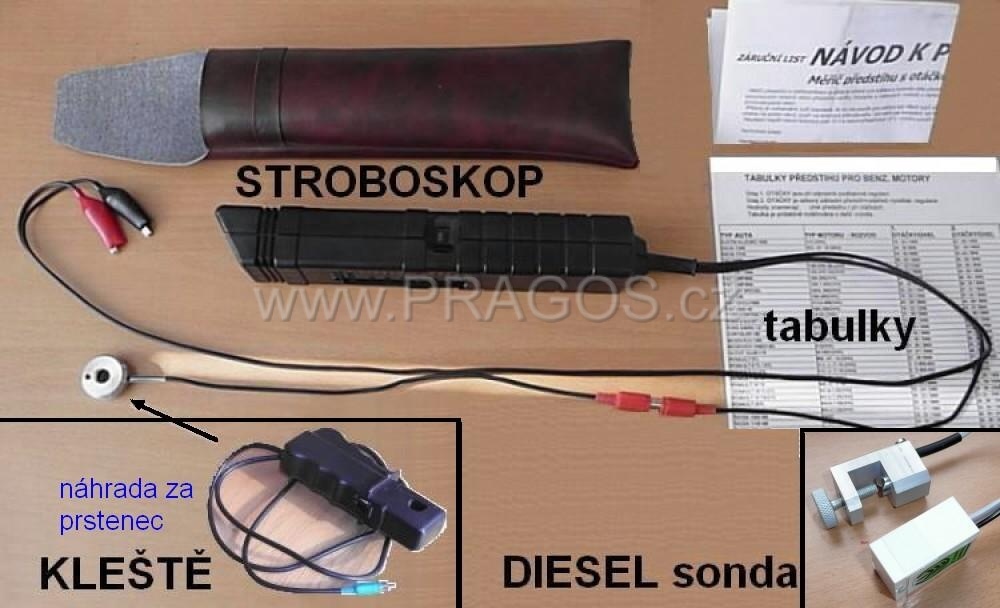
At a great price. A reliable, practical, and inexpensive model suitable even for amateurs. It won a gold medal at the BVV trade fair. It saves fuel, engine wear, and time when adjusting and checking an engine.
What it adjusts and checks
- Ignition timing.
- Engine speed.
- Distributor advance operation, both vacuum and centrifugal.
- Injection timing on diesel engines.
Suitable engines
For diesel and gasoline engines, both four-stroke and two-stroke; divide the measured speed by two for two-stroke engines. The instrument can be used with any number of cylinders. For a vehicle not listed below, however, you must obtain the adjustment data yourself.
Voltage: 6–16 V. On vehicles with a 6 V electrical system, connect the stroboscope to a 12 V source, such as another car battery.
Available items
- STROBOSCOPE kit: the functional base unit.
- CLAMP: an accessory for easier clip-on connection; without it, the cable must be threaded through the circular sensor.
- DIESEL SP probe: an accessory required for diesel engines.
Included
Receipt with an itemized VAT breakdown, warranty, instructions, and a values table for the following vehicles: ŠKODA 1203, 100, 110, R, LS, 105, 120L, LS, GLS, 130L, GL, RAPID, 136, and FAVORIT; VAZ 2101, 2103, 2105, 2106, and 21011; MOSKVICH 2138 and 2140; VOLGA GAZ 24; DACIA 1300; FIAT 1300p; OLTCIT 11R.
Description
The MP1 stroboscope is housed in a black case made of mechanically durable material. The instrument measures engine speed and ignition advance angle and can also check correct operation of the distributor's centrifugal advance, vacuum advance, and more.
Another use is checking the engine's mechanical condition. On a new or sound engine, the flash appears at exactly the same moment whenever any rotating point is illuminated. “Stretched” timing components and poor engine condition are very easy to see under the stroboscope: various clearances make the rotating part of the engine jump irregularly from side to side. On an engine in good technical condition, the timing mark on the pulley remains in one place. Together with a generator, the instrument lets us observe rapidly changing, regularly repeating events that the naked eye could never detect.
Technical specifications
- Operating voltage: 10–14 V.
- Short-duration test: 21.5 V / 10 sec / 2,000 rpm.
- Current draw: 2 A at 13.8 V / 50 Hz; 3.5 A / 100 Hz.
- Maximum flash-tube frequency: at least 100 Hz, i.e. 100 flashes per second = 12,000 rpm on a four-stroke engine.
- Maximum measured speed: 6,000 rpm.
- Flash-tube life: tested to 2,000,000 flashes at the stated current load.
- Tachometer: 12 LEDs.
- Input sensitivity: 2.0 V for both tachometer and stroboscope.
- Maximum tachometer error:
- Stroboscope accuracy: the delay between the signal passing from the input sensor and the lamp discharge is practically immeasurable, meaning the stroboscope itself has 0% error.
- LED scale 1: the basic range advances in 500 rpm increments on the cable to cylinder no. 1; total range 0–6,000 rpm / 12 LEDs.
- LED scale 2: on the lead to the distributor it is four times “denser,” i.e. in 125 rpm increments; total range 0–1,500 rpm / 12 LEDs.
- Sensor: toroidal probe; an impulse-sensing clamp is available separately.
- Protection: reverse-polarity protection and electronic overcurrent protection.
To illuminate the measured point sufficiently, enough energy must be supplied to the flash tube. Flash-tube stress rises directly with engine speed. For long xenon flash-tube life, we recommend a duty cycle at 2,000 rpm of 10 seconds flashing followed by 10 seconds at rest, approximately 1:1, to allow cooling.
Tables included in the package
Gasoline engines – ignition timing
- AUSTIN: ALLEGRO 1500.
- DACIA: 1300, 1310.
- FIAT: 500D, 125 P/1300, 125/1500, 126 P/600, 126 P/650, 127 SPECIAL, 128, 131 CL/1600, UNO 45.
- FORD: CORTINA 1.6, ESCORT 1.3, SIERA 1.6.
- CHRYSLER: 180.
- MOSKVICH: 1360, 1500 (2140).
- OLTCIT: CLUB 11R.
- RENAULT: 5TL, 9 TL/GTL, 11 GTL, 16 TS/TX, 18 TL/GTL/TS/GTS, 20 TL, FUEGO TS/GTS.
- ŠKODA: Š 1203, MB 1000/1100, 100-/L, 110L, 110 LS/R, 105 S/L/GL, 120 L/GL/GARDE/RAPID, 130 RAPID, 135 L/GL/RAPID, 136 L/GL/RAPID/FAVORIT.
- TALBOT: 1510 LS.
- TATRA: 613.
- VAZ: 2101, 2102, 21011 (LADA 1200/1300), 2103 (LADA 1500), 2105 (LADA 1300 S), 2106 (LADA 1600), 2121 (NIVA 1600).
- VOLGA: GAZ 24.
- VOLVO: 360 GLS, 244 GL.
- ZASTAVA: 1100.
Diesel engines – injection timing
- ALFA: 75-2.0, 145-2.5.
- AUDI: 80-1.6, 80-1.9, 100-2.0, 100-2.4.
- AVIA: A15+ 20 (A712.13), A30 (A712.11), A21+31 (A712.18).
- CITROEN: AX-14, ZX-1.8, ZX-1.9, BX-17, BX-19, XANTIA-1.9.
- FIAT: 127, FIORINO, RITMO, STRADA, REGATA-1.7, RITMO/REGATA-1.9, TIPO-1.9, TEMPRA-1.9, TEMPRA-TD, CROMA-1.9, CROMA-2.5, DUCATO-2.5.
- FORD: FIESTA-1.6, ESCORT/ORION-1.8, SIERA-1.8, SIERA-2.3, SCORPIO, TRANSIT-2.3, TRANSIT-2.5.
- LAND ROVER.
- LIAZ: ML635, ML636, MŠ640F.
- MAZDA: 323-1.7, 626-2.0.
- MERCEDES: 190-2.0, 190-2.5, 190-2.5, 240, 300, 200, 250, 300.
- NISSAN: PATROL-3.2.
- OPEL: KADET-1.6, CORSA-1.5, OMEGA-2.3.
- PEUGEOT: 305-1.9, 306-1.9, 309-1.8, 309-1.9, 405-1.7, 505-2.5.
- RENAULT: 19, 21, TRAFIC, MASTER-2.5.
- TATRA: T3-929-11, 14, 18, 19, 30, 32.
- VW: POLO-1.3, GOLF-1.6, PASSAT/SANTANA, GOLF-1.9.
- ZETOR: 5201, 6201, 6901, 7201, 7701.